
























Press Review
Softi Trading and Softi Weekly in the international financial press: articles, market analysis and insights on automated trading and artificial intelligence applied to the markets.
They talk of Us


Press Review
194


Softi Weekly on Money.it
Every week Lorenzo Vaccarella publishes insights on automated trading, AI and financial innovation.

Diversification, what it really means and why it is often misunderstood
Diversification is not only about spreading capital across several instruments. The article clarifies the concept of correlati…

Financial cybersecurity. Why information security has become central to the markets
Cybersecurity is no longer a technical topic reserved for specialists, but an essential component of financ…

Who really moves prices? The role of institutional investors, market makers and flows
The final price is often the result of a more complex structure than it seems. The flows generated by large oper…
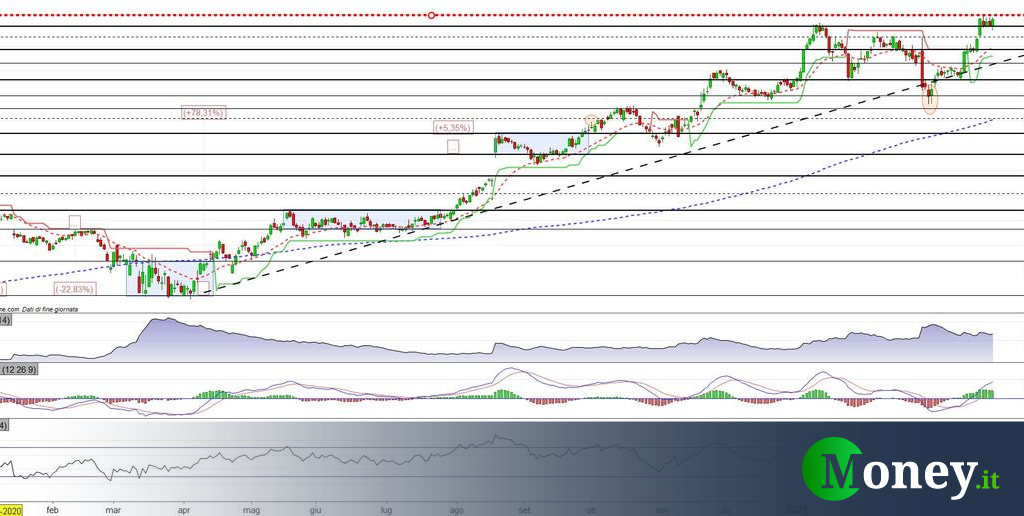
Time horizon and financial goals. The mistake many investors make at the beginning
Investing starts from goals and time horizon, not from instruments. The most common mistake is choosing first the…
Spread, slippage and execution. The invisible costs that affect trades
Spread, slippage and execution latency are the hidden costs that erode trading results. Do not rely only on the…
Market liquidity: why it matters more than it seems
Liquidity is a market's ability to absorb orders without moving the price. Low-liquidity markets amplify …
How to truly read the risk-return ratio in investments
There is no return without exposure to some form of uncertainty. The article explains how to read and interpret the relat…

Digitalization of payments and the end of cash
The transition to digital payments is redefining the global financial system. Contactless, payment apps,…

Demographics and financial markets. Why population ageing will change investments and growth
Demographic ageing is one of the most powerful and predictable forces that will shape markets over the coming decades…

Strategic raw materials and the energy transition
Lithium, copper, nickel and rare earths have become strategic resources in the energy transition. Competition for…
Volume, depth and volatility. How to read the quality of a market
Not all markets are the same. Trading volumes, order book depth and volatility structure determine the qual…

Geopolitics and financial markets. Why conflicts affect currencies, commodities and investments
Geopolitics is no longer an episodic element, but a structural component of financial analysis. Conflicts, sancti…

Inflation, interest rates and financial markets. How investor behaviour is changing
The inflation-interest rate cycle is the most relevant macro driver for financial markets. The article analyses how…

Dollar, euro and yuan. The new global currency competition
Competition between the dollar, the euro and the yuan reflects the redefinition of global power balances. De-dollarisati…

Global public debt. Systemic risk or a new financial normal?
Global public debt has reached historic levels. The article analyses whether this represents a systemic risk …

Interest rates and the economic cycle. What changes for savers and businesses
Interest rates are the transmission mechanism through which monetary policy reaches the real economy. The article explains wh…

Geopolitics and markets. How the new global balances affect investments and currencies
The new geopolitical balances — from US-China competition to tensions in Europe — are reshaping the flows of in…

Structural inflation: why we will never return to the era of easy money
The article analyses the structural causes of the persistent inflation that is shaping the global economy. They…

Ethics and governance of automated finance: who will control the algorithms of the future?
Financial automation raises fundamental questions about accountability and transparency. Who is responsible when…

The new era of digital currencies: central banks and stablecoins compared
CBDCs and stablecoins represent two different approaches to the digitalization of money. Central banks aim to con…

Open finance and data sharing: towards a transparent financial ecosystem
Open finance is revolutionising the way financial data is shared and used. Open APIs and standards…

Generative AI and predictive finance: analysis, scenarios and risks
Generative AI is transforming financial analysis, making it possible to process complex scenarios and generate insights in…

Quantum computing and financial markets: the next data revolution
Quantum computing promises to revolutionise financial analysis, enabling calculations that are impossible for today's computers…

The tokenisation of real assets: the bridge between traditional and digital finance
Tokenisation makes it possible to represent real assets (real estate, art, commodities) on the blockchain, increasing liquidit…
The ethical side of automation in the markets: opportunity or social risk?
Financial automation offers efficiency but raises ethical questions about transparency, accountability and inequalit…

From retail to institutional: how automation is levelling the playing field
For decades, institutional investors have had access to tools and technologies denied to retail traders. Automatio…

Data and algorithms: the new oil of the financial markets
In modern trading, data is the most valuable resource. Those who have access to quality data and algorithms to process it have…

Trading and sustainability: the impact of technology on energy and resources
Automated trading and AI consume significant energy resources. How to balance financial efficiency and sustain…
Market volatility: why automation can turn a risk into an opportunity
Volatility scares many traders, but for those who know how to handle it, it represents an opportunity. Automated systems excel…

The future of trading between blockchain, artificial intelligence and advanced automation
Trading is undergoing an epochal transformation. Blockchain, AI and automation are converging to create an ecosyst…
Automated trading and retail investors: democratization or a new barrier?
Automated trading promises to level the playing field between retail and professionals, but is that really the case? The article analyses…

When automated trading becomes a financial planning tool
Automated trading is often seen as speculation, but it can become part of a financial planning strategy…

Artificial intelligence in trading: hype or real revolution?
AI in trading is everywhere, but how much is hype and how much is substance? The article separates unrealistic promises from applications…
Cryptocurrencies: why automated trading can make the difference
The crypto market operates 24/7 with extreme volatility: ideal conditions for automated trading. The article explains why…
Automated trading: a real opportunity or an underestimated risk?
Automated trading attracts with promises of passive gains, but hides risks that many underestimate. The article off…

Automated cryptocurrency trading with Softi Bit's AI
Softi Trading presents Softi Bit, an advanced software for automated cryptocurrency trading. Based on intellig…
Softi Weekly
Guides, market analysis and insights from the Softi Trading team.
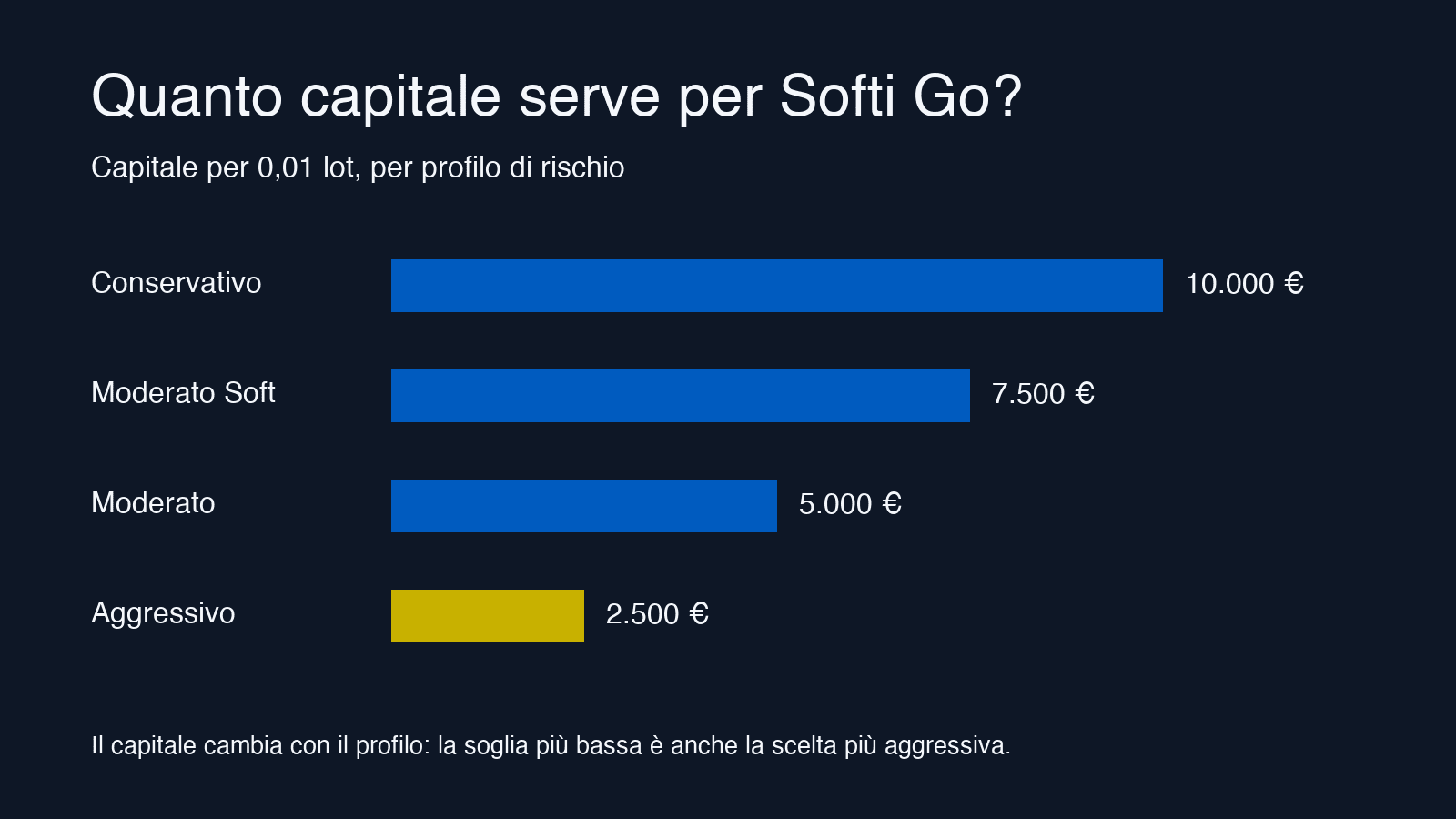
Capitale Softi Go: quanto serve per ciascun profilo
Per Softi Go, 2.500 € corrispondono al profilo Aggressivo con 0,01 lot. Il capitale necessario cambia con il lottaggio e con il profilo di rischio scelto: la soglia da sola non basta.

Requotes and slippage: handling rapid price changes
On a low-quality broker the spread on EUR/USD rises to 2-3 pips: fifteen trades a month amount to 360 pips of cost in a year. Softi Go operates on EUR/USD at M30, with a basic news filter.

Automated trading costs: spread, slippage and commissions
Every trade you open has hidden costs that appear in no notification. Spread, slippage and commissions erode profits — here's how to calculate them and how automated trading handles them.